

What Is a Credit Card Surcharge? A Complete Guide to Credit Card Surcharge Fees
If you’ve ever paid for something and noticed a small extra charge tacked on because you used a credit card, you’ve run into a credit card surcharge.
These fees have become far more common over the past decade, showing up at restaurants, contractors’ offices, doctors’ waiting rooms, and checkout pages across the country.
But what exactly is a credit card surcharge, is it legal, and how does it actually work? This guide breaks it all down.
What Is a Credit Card Surcharge?

A credit card surcharge is an extra fee a business adds to a transaction when a customer chooses to pay with a credit card instead of cash, check, or debit.
The purpose is simple: credit card processing isn’t free for merchants.
Every time a customer swipes, taps, or enters a credit card number, the business pays a percentage of that transaction — typically somewhere between 1.5% and 3.5% — to the card networks, the issuing bank, and their payment processor.
A surcharge lets the merchant pass some or all of that cost directly to the customer who’s creating it, rather than absorbing it into their overall prices.
In plain terms: the surcharge exists because accepting your credit card costs the business money, and the surcharge shifts that specific cost onto the specific transaction that caused it.
It’s worth noting what a surcharge is not:
- It’s not the same as your credit card’s own fees (annual fees, interest, cash advance fees) — those come from your card issuer, not the merchant.
- It’s not a “convenience fee,” which is a flat or percentage fee charged for using an alternative payment channel (like paying a bill by phone or online) regardless of card type.
- It’s not a “service fee” or “processing fee” in the generic sense some businesses use — though in practice, these terms often get used loosely and interchangeably.
How Surcharge Credit Card Fees Actually Work
When a merchant sets up a surcharge program, here’s generally what happens at checkout:
- The customer selects credit card as their payment method.
- The point-of-sale system or payment gateway detects the card type. This step matters a lot — surcharges can only legally apply to credit cards, never debit cards, so the system has to distinguish between the two.
- A surcharge percentage is added to the transaction total, usually shown as a separate line item (e.g., “Credit Card Surcharge: 3%”).
- The customer sees the total price, inclusive of the surcharge, before completing the purchase — in states and under card network rules that require advance disclosure, this has to happen before the card is charged, not buried in fine print afterward.
- The merchant is required to post signage or checkout disclosures letting customers know a surcharge applies, both in physical locations and on online checkout pages.
Because the fee is tied to the type of payment used, customers can typically avoid it altogether by paying with cash, check, or a debit card — which is one of the legal distinctions that keeps surcharging separate from a straightforward price increase.
Surcharge vs. Convenience Fee vs. Cash Discount
These three terms get mixed up constantly, but they work differently:
| Fee Type | When It Applies | Card Type |
| Surcharge | Added specifically because the customer used a credit card | Credit only |
| Convenience fee | Added for using an alternative payment channel (phone, online portal) | Any card type, sometimes all electronic payments |
| Cash discount | The “surcharge” is built into the sticker price, and cash-paying customers get a discount off it | Effectively achieves the same cost-shifting, but structured as a discount rather than a fee |
Many businesses that operate in states with strict surcharge rules use cash discount programs instead, since they accomplish a similar financial outcome through different legal mechanics — the listed price already includes the card-processing cost, and customers who pay with cash get a reduction.
Is a Credit Card Surcharge Legal?
Generally, yes — credit card surcharging is legal in most of the United States, but the details vary quite a bit by state, and the legal landscape has shifted significantly over the past several years.
A bit of background: For decades, Visa and Mastercard’s merchant agreements banned surcharging outright.
That changed after a class-action antitrust settlement in 2013, which opened the door for merchants to surcharge nationally, subject to card network rules and any state laws that still prohibited it.
The Supreme Court’s 2017 decision in Expressions Hair Design v. Schneiderman further shaped the landscape by treating surcharge pricing as a form of commercial speech, which triggered a wave of court challenges to remaining state bans.
Where things stand today (2026):
- A small number of states still maintain active, enforced bans on credit card surcharges — most consistently Connecticut and Massachusetts, with Maine and Puerto Rico also generally cited as prohibited jurisdictions.
- A handful of states allow surcharging but cap the amount or add conditions. Colorado, for example, caps surcharges at 2% regardless of a merchant’s actual processing cost. Other states require that the surcharge not exceed the merchant’s actual cost of accepting the card.
- States like California, Texas, Florida, and Oklahoma have surcharge bans on the books that federal courts have found unconstitutional, which has created a confusing gray zone — surcharging is effectively happening in these states, but enforcement postures and legal risk differ, and the situation has continued to shift through legal challenges and legislative activity.
- Debit card surcharges are prohibited essentially everywhere, regardless of what a state allows for credit cards. This is treated as settled and consistent across sources.
- Several states have passed or proposed new legislation in 2025 and 2026 specifically addressing debit card surcharges, disclosure requirements, or new caps — meaning this is an actively moving area of law.
Because state laws, card network rules, and court rulings keep shifting, this is genuinely one of those topics where “check current guidance” isn’t a throwaway line — it’s necessary. If you’re a business owner considering a surcharge program, or a consumer trying to understand your rights, verify the current rules for your specific state (and consult an attorney or your payment processor’s compliance team) rather than relying on a general guide, including this one.
Card Network Rules on Surcharging
Even where state law permits surcharging, Visa and Mastercard impose their own requirements that merchants must follow:
- Maximum surcharge caps — generally around 3% (Visa) or up to 4% (Mastercard), though the surcharge can never exceed the merchant’s actual cost of acceptance.
- Advance registration — merchants often need to notify their card networks or acquiring bank before implementing a surcharge program.
- Clear disclosure — signage at the point of entry, at the point of sale, and (for online transactions) on the checkout page before payment is submitted.
- Uniform application — a merchant generally can’t surcharge one card brand and not another, or apply the surcharge inconsistently across transactions.
- No surcharging debit or prepaid cards, even if they’re run through a Visa or Mastercard network.
Failing to follow these rules can expose a merchant to fines from their payment processor or acquiring bank, in addition to any state-level penalties.
Why Businesses Add Surcharges

For many small and mid-sized businesses, credit card processing costs are a real and growing expense. On a $100 transaction, a 2.5–3.5% processing fee means $2.50 to $3.50 disappears before the business sees a dime of profit. For businesses operating on thin margins — restaurants, service providers, contractors — that adds up fast over a year of transactions.
Surcharging lets a business:
- Recover processing costs without raising prices for everyone. Cash-paying customers aren’t affected, only card users who trigger the cost.
- Keep sticker prices competitive while still covering the real cost of accepting cards.
- Encourage lower-cost payment methods like debit or ACH transfers, which cost the merchant less to process.
What It Means for Consumers
From a shopper’s perspective, a surcharge is essentially a small tax on convenience — you’re paying a bit more to use a credit card instead of cash or debit. A few practical takeaways:
- You can usually avoid it. Paying with cash, check, or debit typically sidesteps the fee entirely.
- It should be disclosed clearly before you pay, not added as a surprise on your receipt. If a business isn’t telling you about a surcharge upfront, that’s worth questioning — and in many states, it may not be compliant with disclosure laws.
- It’s usually a modest percentage, typically in the 1.5–3.5% range, though state caps can bring that lower.
- Rewards card users should do quick math. If your credit card rewards rate (say 2% cash back) is lower than the surcharge (say 3%), you’re coming out behind by using that card at that business — even though you’re earning “rewards.”
Setting Up a Surcharge Program: The Basics for Merchants
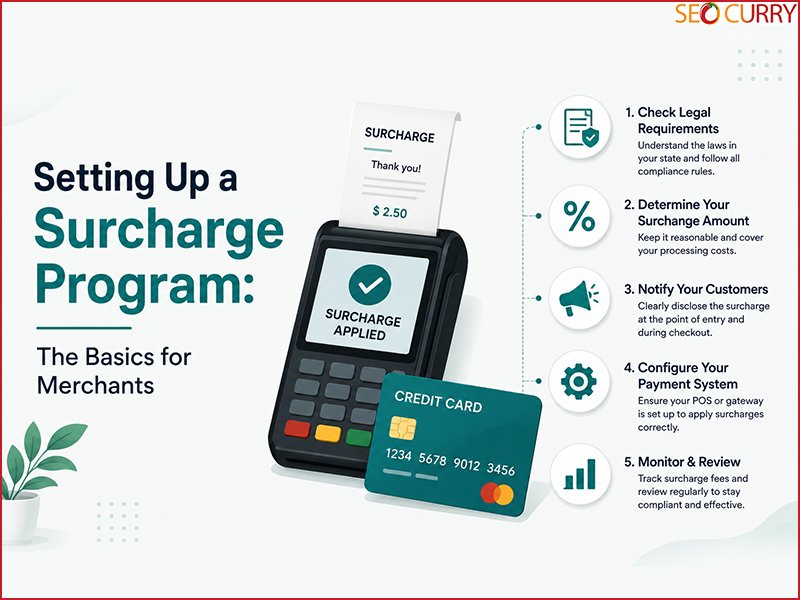
If you’re a business owner considering surcharging, the general steps look like this:
- Confirm it’s legal in your state and note any caps or conditions that apply.
- Check with your payment processor about registration requirements and their specific surcharge tools.
- Configure your POS or payment gateway to correctly detect credit vs. debit cards and apply the surcharge only where allowed.
- Set the surcharge rate, keeping it at or below your actual processing cost and within any card network or state caps.
- Post required disclosures — signage in-store and clear notices at online checkout — before the customer completes payment.
- Keep records in case of a compliance audit, and revisit your program periodically since surcharge laws change fairly often.
The Bottom Line
A credit card surcharge is a fee merchants add to offset the cost of accepting credit card payments, applied only to credit card transactions and disclosed to the customer in advance.
It’s legal in the majority of U.S. states, though a small set of jurisdictions ban it outright, several states cap it or add conditions, and card network rules layer additional requirements on top.
Because this area of law keeps evolving — with new state bills, court rulings, and card network policy updates surfacing regularly — both merchants and consumers benefit from checking current, state-specific guidance rather than assuming last year’s rules still apply.
This article is for general informational purposes and isn’t legal or financial advice. Surcharge laws vary by state and change frequently — consult a qualified attorney or your payment processor’s compliance team before implementing or evaluating a surcharge program.